

LOST IN TRANSLATION
Why Low Levels of Vitamin D May Be Sabotaging Drug Trials—and Why it Matters for the Rest of Us

In the context of pharmaceutical development “translation” refers to the eventual application (translation) of preclinical discoveries - usually new drugs - utilizing experimental preparations like lab animals to humans. The issue with vitamin D status is that the lab animals in the preclinical testing are all replete in vitD while the humans in the eventual clinical trials are not. Is this an oversight - which would equate to scientific malpractice - or purposeful?
The Multi-Billion-Dollar Mystery
Every year, pharmaceutical companies invest tens of billions of dollars developing new medicines. Brilliant scientists spend careers in the lab. Promising results pile up. Then those drugs enter human clinical trials—and most of them fail.
Not a little. A lot. About nine out of every ten drugs that reach the first stage of human testing never make it to pharmacy shelves (Sun et al., 2022; Arora et al., 2021). The most common reason isn’t that the drugs turn out to be dangerous. It’s that they simply don’t work in real human patients the way they worked in the lab.
The price tag for this failure is staggering. Bringing a single approved drug to market now costs more than $2.6 billion on average (Arora et al., 2021)—and that doesn’t count all the drugs that failed along the way.
Scientists have long debated why this happens. Bad animal models. Overhyped early results. Biological differences between mice and humans. All of these play a role.
But this paper argues there is an important culprit that has been hiding in plain sight: vitamin D.
Vitamin D Is Not Just a Vitamin
Vitamin D is actually a powerful steroid hormone. When sunlight hits your skin, it triggers a chain of chemical reactions that ultimately produce a molecule called calcitriol—the active form of vitamin D. This molecule travels to almost every one of the 37 trillion cells in the your body and switches genes on and off (Prietl et al., 2013).
More than 300 genes are regulated by vitamin D (Sìrbe et al., 2022). Many of them control the immune system—your body’s defense force against infections, cancer, and its own misfiring cells.
Here is why that matters for drug development: the most exciting class of new medicines being developed today—drugs that harness or redirect the immune system—depend entirely on having an immune system that functions in a predictable way. If vitamin D quietly shapes how that immune system works, then vitamin D levels in the people receiving those drugs will directly influence whether the drugs appear to work at all.
The Lab Rat Problem: Well-Fed in Ways Humans Are Not
To understand the issue, you need to know something about how drug experiments begin. Before any medicine is tested in humans, it is tested in laboratory animals—usually mice and rats.
These animals live carefully controlled lives. Their food is precisely formulated. And their food, it turns out, is remarkably rich in vitamin D.
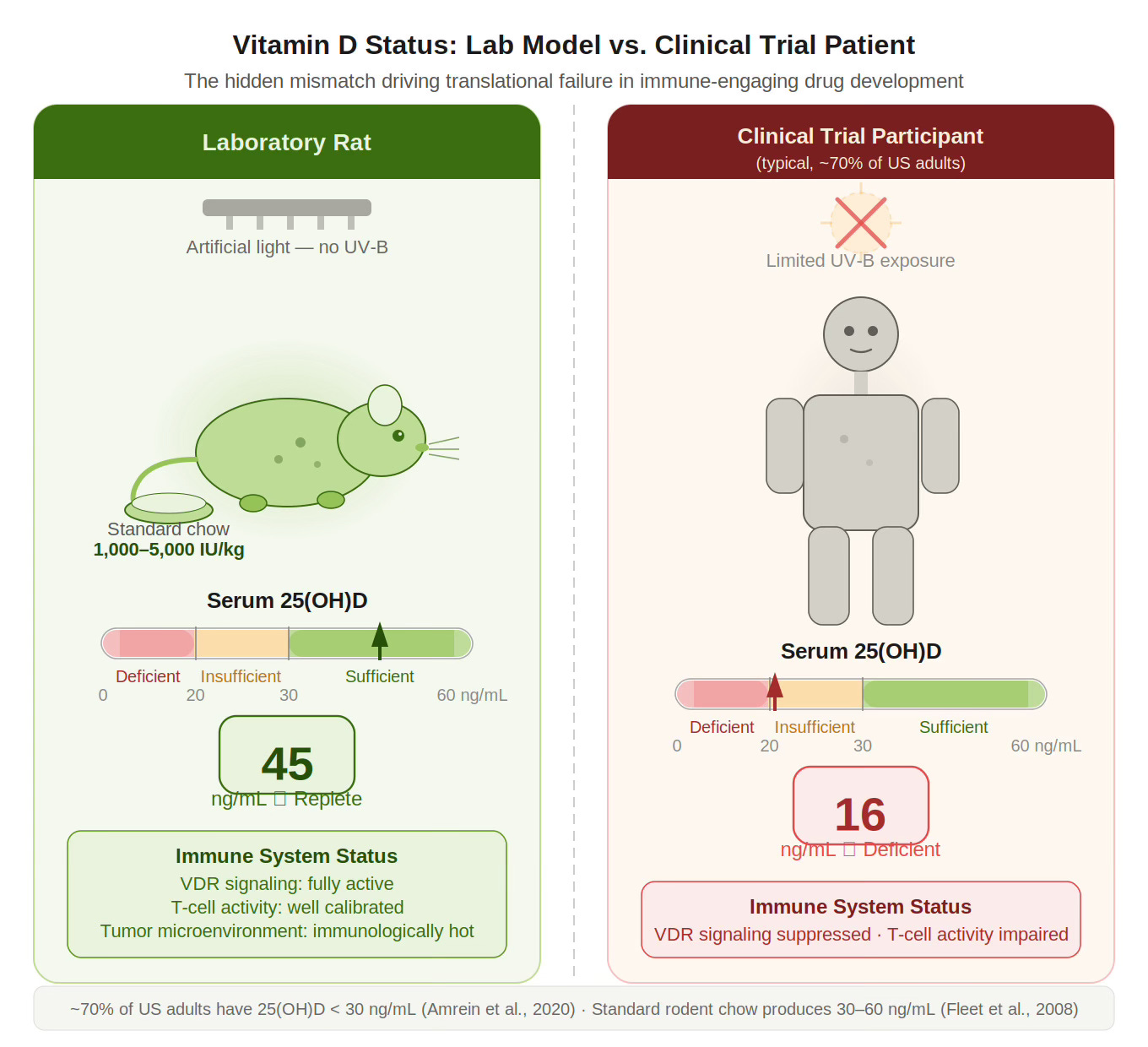
Standard rodent chow contains between 1,000 and 5,000 IU of vitamin D per kilogram of food (Reeves et al., 1993; Fleet et al., 2008). The result is that lab animals maintain blood levels of vitamin D in the range of 30 to 60 ng/mL—a state of complete sufficiency (Shaughnessy & Fleet, 2018; Wakefield et al., 2019). They live their entire lives in this well-nourished state.
These animals also live under artificial lighting that produces no ultraviolet rays, so they cannot make any vitamin D through their skin. But it doesn’t matter—their food provides plenty.
A Hidden Bonus Confound: Extra Calcium
Standard rodent diets are also unusually high in calcium—typically 0.5–1.0% of the diet by weight (Wakefield et al., 2019). Why does this matter? Because one of the most important jobs of vitamin D is to help the body absorb calcium from food. When calcium is already sky-high in the diet, the body doesn’t need to work as hard to get it. This masks many of the biological signs that would normally indicate vitamin D deficiency (Fleet et al., 2008).
In other words, even in the rare studies where researchers try to reduce vitamin D in lab animals, the excess calcium in the food partially covers for it. The animal “looks” healthier than it should. A truly vitamin D–deficient animal model—one that would actually resemble a vitamin D–deficient human—would require both reducing vitamin D in the food and reducing calcium to human-normal levels. This almost never happens in standard pharmaceutical research.
The Human Reality on VitD: Most of Us Are Running Low or Starving
Now consider the humans who ultimately participate in clinical trials of these same drugs.
Using data from the National Health and Nutrition Examination Survey (NHANES)—a large, ongoing study of health in the United States—researchers found that roughly 70% of American adults have vitamin D levels below the threshold (30 ng/mL) that the Endocrine Society defines as sufficient (Amrein et al., 2020). A more recent analysis of over 71,000 Americans confirmed that only about one in three adults has truly sufficient vitamin D levels (Cui et al., 2022).
Globally, the numbers are even more striking. A massive analysis pooling data from 7.9 million people across 81 countries found that vitamin D deficiency or insufficiency affects the majority of adults in most parts of the world (Cui et al., 2023).
Certain groups fare especially badly. African Americans have deficiency rates exceeding 80% in some studies (Forrest & Stuhldreher, 2011). Older adults, people with obesity, and those in northern climates are all disproportionately affected. And the populations most likely to be enrolled in clinical trials for immune-related drugs—people with cancer, autoimmune disease, and chronic infections—tend to be among the most vitamin D–deficient of all.
In one striking example: among patients with advanced cancer who were enrolled in an immune checkpoint inhibitor study, 94.1% had insufficient vitamin D levels at the start of treatment (Kouchaki et al., 2023).
The Structural Confound: Two Different Biological Worlds
Put these two pictures together and the problem snaps into focus.
Lab animals live their entire lives in a state of vitamin D sufficiency. Every immune cell they have is bathed in calcitriol. Their immune systems are calibrated one way.
Human trial participants are predominantly vitamin D–deficient. Their immune cells are not receiving those vitamin D signals. Their immune systems are calibrated a different way.
When a drug is developed in the first environment and then tested in the second, it is not simply being tested in a different-sized body and in a different species. It is being tested in a fundamentally different immunological context: sufficient Vitamin D or insufficient Vitamin D. The very biological machinery the drug was designed to engage is operating differently—and nobody in the development pipeline appears to be measuring or accounting for it.
One analogy: imagine developing an antidepressant in animals with normal serotonin levels, and then testing it in humans whose serotonin systems are already depleted. The drug might work beautifully in the first setting and appear to do almost nothing in the second—not because the drug is ineffective, but because the underlying biology it was designed to act on has been changed by an unaccounted-for variable.
How Vitamin D Shapes the Immune System
To appreciate why this matters specifically for immune-engaging drugs, it helps to understand what vitamin D actually does in the immune system.
The vitamin D receptor—the molecular “lock” that calcitriol fits into—is found on virtually every type of immune cell: macrophages, dendritic cells, T cells, B cells, and regulatory T cells (Prietl et al., 2013; Hewison, 2012). When calcitriol activates these receptors, it triggers a cascade of effects (Sìrbe et al., 2022):
• It promotes the ability of macrophages to kill bacteria and other pathogens.
• It stimulates the production of natural antimicrobial compounds in the body.
• It influences how dendritic cells “present” threats to the rest of the immune system.
• It encourages the growth of calming, regulatory immune cells while suppressing inflammatory ones.
• It reduces the production of inflammatory proteins like TNF-α, IFN-γ, IL-12, and IL-17.
• It directly influences the molecules on tumor cells that immune checkpoint inhibitor drugs use as their targets (Zhang et al., 2025).
In cancer specifically, vitamin D shapes what scientists call the tumor microenvironment—the ecological community of immune cells, blood vessels, and signaling molecules that surround and infiltrate a tumor. A vitamin D–sufficient tumor microenvironment tends to be more immunologically active: it has more cancer-killing T cells, fewer tumor-protecting regulatory cells, and a more favorable balance of immune signals. This is exactly the kind of environment in which immune-boosting cancer drugs work best (Zhang et al., 2025).
Vitamin D deficiency removes all of that scaffolding—and replaces it with an immunological environment that is tilted toward immune suppression.
Where This Plays Out: Three Drug Classes That Have Suffered
Cancer Immunotherapy: Immune Checkpoint Inhibitors
Immune checkpoint inhibitors (ICIs)—medicines with brand names like Keytruda, Opdivo, and Yervoy—represent one of the most significant breakthroughs in cancer treatment in decades. They work by releasing the “brakes” on the immune system, allowing it to recognize and attack tumors.
In laboratory mice, these drugs have produced remarkable results, sometimes eliminating tumors entirely. But in human clinical trials, the picture has been far more modest. In lung cancer, for example, only about 15–20% of unselected patients respond meaningfully, and fewer than 5% achieve lasting complete remissions on monotherapy (Zhang et al., 2025).
A growing body of evidence points to vitamin D as one reason for this gap. A 2025 review found that patients with adequate vitamin D levels showed markedly better ICI response rates than deficient patients, consistent with vitamin D’s known role in activating the immune machinery these drugs depend on (Zhang et al., 2025).
The PROVIDENCE study—a prospective study of 164 cancer patients receiving ICIs—found that 94.1% of patients had insufficient vitamin D at the start of treatment. When 101 of those patients received systematic vitamin D supplementation alongside their ICI therapy, they showed significantly longer overall survival, longer time to treatment failure, and better disease control compared to a control group that received no supplementation (Kouchaki et al., 2023). These are not minor statistical footnotes—they represent real differences in whether patients lived longer.
A separate study of melanoma patients found that vitamin D deficiency was associated with poor outcomes across multiple types of treatment, leading researchers to recommend that vitamin D levels be measured and corrected in allpatients with advanced melanoma receiving systemic therapy (Kottschade et al., 2022).
A 2025 meta-analysis synthesizing 13 studies covering 2,592 cancer immunotherapy patients found that higher vitamin D was associated with a 53% reduction in the risk of death (HR = 0.47), and that supplementation was associated with a 33% reduction (HR = 0.67).
Moreover, interactions between vitamin D status and adverse side effects of advanced pharmacologics indicate another intricate relationship. Grover et al., (2020) found that patients with higher vitamin D use prior to treatment were over 60% less likely to develop ICI-related colitis.
Multiple Sclerosis: A Cautionary Story
Multiple sclerosis (MS) offers a more complicated case—and an instructive one. MS is an autoimmune disease in which the immune system mistakenly attacks the brain and spinal cord. For decades, the standard treatment was a drug called interferon-beta, which works by modulating the immune system.
Vitamin D has long been associated with MS risk and activity: low vitamin D levels are linked to more relapses and worse MRI findings. Each 10-unit increase in vitamin D blood levels was associated with about a 12–14% reduction in new brain lesion activity in studies before treatment began (Løken-Amsrud et al., 2012).
Given this, researchers ran a series of clinical trials—called SOLAR, CHOLINE, EVIDIMS, and VIDAMS—to test whether adding vitamin D supplements to interferon-beta would improve patient outcomes. The results were largely disappointing. None of the trials showed a statistically significant improvement in their primary outcomes (Hupperts et al., 2019; Smolders & Torkildsen, 2019; Cassard et al., 2023; Dörr et al., 2020).
The prevailing conclusion has been that vitamin D doesn’t help MS patients taking interferon-beta. But this conclusion may be premature. These trials had a critical design flaw: they never first stratified patients by their baseline vitamin D levels, nor did they ensure everyone was adequately repleted before the trial started. They added supplements on top of whatever deficiency patients already had. The question the trials never answered is the one that matters most: does interferon-beta work differently in patients who are vitamin D–sufficient versus deficient? That properly designed trial has yet to be run.
Rheumatoid Arthritis and Other Autoimmune Diseases
In rheumatoid arthritis (RA)—where the immune system attacks the joints—biologic drugs like TNF inhibitors and others have been developed in vitamin D–replete animal models. In humans, vitamin D deficiency is common among RA patients and is associated with higher disease activity and poorer response to biologic treatment (Harrison et al., 2020). The biological logic is clear: these drugs target inflammatory proteins that are already amplified by vitamin D deficiency. Correcting the deficiency might reduce the very inflammation the drug is trying to treat, yet vitamin D status is almost never measured or controlled in RA drug trials.
The COVID-19 Natural Experiment
The COVID-19 pandemic offered a dramatic real-world test of the relationship between vitamin D and immune drug performance. Multiple early studies in lab animals and observational human data suggested strong protective effects of vitamin D against severe disease. But when these findings were tested in randomized controlled trials, results were inconsistent.
A critical reason: many of these trials enrolled patients who were already severely ill and gave them large one-time doses of vitamin D—too late for the immune benefits to kick in. The preclinical models had always assumed vitamin D was already present before the immune challenge occurred. This timing issue is simply another face of the same structural confound (Hewison, 2012; Prietl et al., 2013).
What Can Be Done: Practical Fixes for a Fixable Problem
The good news is that this problem is not theoretical, and the solutions are not exotic. They require no new scientific discoveries—only the application of knowledge we already have.
1. Measure Vitamin D in Every Relevant Trial
The most immediate fix is simply measuring vitamin D levels—specifically the blood marker called 25-hydroxyvitamin D [25(OH)D]—at the time every participant enrolls in an immune-engaging clinical trial. This is a cheap, standardized test. It costs less than a basic metabolic panel and is available in any clinical laboratory. Right now, the majority of immune-drug trials do not require it. Making it mandatory would cost almost nothing and would generate enormously valuable data for interpreting outcomes.
2. Sort Participants by Vitamin D Status
Beyond measuring, trial designers should group (“stratify”) participants by their vitamin D levels before the trial begins. This is already done routinely for other biological markers in cancer trials—why not for vitamin D? Such stratification would allow researchers to see whether the drug works better in sufficient patients versus deficient ones. If it does, that tells scientists something crucial about the drug’s mechanism. It could also rescue drugs that failed to show efficacy in the general population but actually work well in vitamin D–sufficient patients.
3. Correct Vitamin D Deficiency Before the Trial Starts
An even more direct approach: bring all participants to vitamin D sufficiency before administering the drug being tested. If the drug was developed in animals with blood vitamin D of 30–60 ng/mL, doesn’t it make sense to test it in humans whose levels are in that same range?
Achieving adequate vitamin D is straightforward. Most adults can reach levels of 40–60 ng/mL with supplemental cholecalciferol (vitamin D3) of approximately 3,000–5,000 IU per day over 8–12 weeks (Holick, 2007). Vitamin D3 supplements are inexpensive, widely available without a prescription, and have an excellent safety record at these doses. The PROVIDENCE study effectively demonstrated this approach and saw meaningful clinical benefits (Kouchaki et al., 2023).
4. Make Pre-Clinical Animal Models More Realistic
On the preclinical side, researchers should consider maintaining laboratory animals at vitamin D levels that actually match what human patients have. This means restricting dietary vitamin D in the animal’s food to produce blood levels of 10–15 ng/mL—comparable to deficient humans—while also lowering dietary calcium to human-normal levels. Some researchers have successfully done this and shown it is feasible (Belenchia et al., 2016). Testing a drug in a vitamin D–deficient animal model would give a far more honest prediction of how it will perform in the majority of human patients who are themselves deficient.
However, this adjustment seems misguided when the more reasonable approach is to make the human subject vitamin D replete.
5. Require VitD Reporting in Publications and Regulatory Filings
At a systemic level, scientific journals and regulatory agencies like the FDA and EMA should require that vitamin D status be reported as a standard variable in trials of immune-engaging drugs. Journals already require reporting of race, sex, age, and key health markers. Vitamin D status belongs on that list for any trial in which the immune system is the target.
Why This Matters to You
If you or someone you love has been treated with an immune checkpoint inhibitor and experienced a modest response, or has struggled to achieve remission with a biologic drug for an autoimmune disease, vitamin D deficiency may have been an invisible factor.
If you have watched clinical trials for promising cancer drugs fail and wondered why, vitD differences causing a lost-in-translation effect is one plausible answer.
The structural mismatch described here—vitamin D–replete animals, vitamin D–deficient humans—creates a systematic bias in drug development that deflates the apparent performance of drugs in clinical trials. Drugs that genuinely work in a vitamin D–sufficient immune environment may fail statistical tests when the majority of trial participants are operating with a compromised immune baseline. Some of those drugs may have been abandoned when they should not have been.
Correcting vitamin D deficiency before or during immunotherapy is not a substitute for the drugs—it is a prerequisite for giving those drugs the immune environment they were designed to work in. Failing to address it is equivalent to testing a sports car on a road covered in mud and then concluding the car is slow.
WHY DOESN’T BIG PHARMA CORRECT THIS PROBLEM?
The evidence presented in this paper raises an uncomfortable question. If vitamin D status is as consequential a variable as the data suggest—if it genuinely explains a meaningful fraction of the gap between promising preclinical results and disappointing clinical ones—why has the pharmaceutical industry not already corrected for it? The short answer is that the industry faces a cluster of structural, economic, and scientific incentives that all point, independently, toward ignoring this variable. Understanding those incentives is necessary for appreciating why remedies require deliberate policy intervention rather than simply better science communication.
The Business Model Is Built Around Failure
It is counterintuitive but important to recognize that a 90% clinical trial failure rate is not a crisis for the pharmaceutical industry as currently organized—it is a baseline that has been priced into the business model. Large pharmaceutical companies run dozens of clinical development programs simultaneously, and they expect most of them to fail. The enormous cost of those failures is bundled into the pricing of the small fraction of drugs that succeed. When a blockbuster cancer drug is approved and priced at $150,000 per year of treatment, a significant portion of that price reflects the industry’s recovery of costs from the many failed programs that preceded it.
This means that there is no financial catastrophe triggering urgent self-examination when a drug fails in Phase III. Failure is normal. The apparatus for absorbing and redistributing failure costs is well established. A company that improved its translational success rate from 10% to 25% by rigorously controlling for vitamin D status would develop better drugs—but it would also undermine the cost-of-failure rationale that justifies current drug pricing. The perverse result is that there is a structural disincentive, embedded in the pricing architecture of the industry itself, to fixing the pipeline too efficiently.
Vitamin D Cannot Be Patented
This is the most direct economic barrier, and it deserves to be stated plainly. Cholecalciferol—vitamin D3—is a naturally occurring molecule. It has been off-patent for decades. It is manufactured generically and sold over the counter for little cost per dose. No pharmaceutical company can obtain meaningful intellectual property protection over vitamin D supplementation.
This creates a profound misalignment between what the evidence supports and what the industry can monetize. If clinical trials stratified by vitamin D status demonstrated that repleted patients respond dramatically better to a given immune checkpoint inhibitor—say, doubling the durable response rate—the medically correct recommendation would be to ensure all patients achieve vitamin D sufficiency before initiating therapy. But that recommendation directs patients toward a product the originating company cannot sell at a profit. Worse, it invites payers, formulary committees, and clinical guidelines to require low-cost vitamin D repletion as a precondition before authorizing expensive drug treatment, potentially shrinking the commercially addressable patient population.
A drug company that openly demonstrated this relationship in its own trial data would be publishing the evidence for its own commercial disadvantage. The rational response—from a narrow financial perspective—is to not measure vitamin D status in the first place, ensuring the question never arises in the trial data.
No One Owns the Problem
The vitamin D confound falls into an organizational gap that is characteristic of large, siloed institutions. The scientists who design preclinical efficacy studies are specialists in pharmacology or oncology, not nutritional biochemistry. The clinicians who design Phase III trials are specialists in their therapeutic area, with protocol decisions driven by regulatory precedent and competitive benchmarking. Regulatory agencies specify what must be measured and reported in trial submissions; vitamin D status is not on that list. The result is that no individual or team within the drug development pipeline has explicit responsibility for the nutritional and endocrine baseline of either the animal models or the human trial participants.
Vitamin D occupies an awkward disciplinary position—it sits at the intersection of nutritional science, endocrinology, and immunology in a way that makes it peripheral to each. The immunologists designing checkpoint inhibitor trials think of PD-L1 expression and tumor mutational burden as their relevant biomarkers, not serum 25-hydroxyvitamin D. The result is an absence of oversight that is not the product of deliberate suppression but of fragmented institutional responsibility.
Regulatory Standards Do Not Require It
Pharmaceutical companies are rational actors within regulatory frameworks. The FDA and EMA specify extensive requirements for what must be measured, reported, and controlled in clinical trials. Baseline vitamin D status is not among them. In the absence of regulatory mandate, companies have no competitive incentive to add a variable that could complicate data interpretation, slow enrollment, extend trial timelines, or raise questions about their drug’s efficacy in a deficient population. Until regulators treat vitamin D status as a required covariate for immune-engaging drug trials—analogous to the now-standard reporting of PD-L1 expression in oncology trials—the market will not self-correct.
Failed Drugs Are Not Always Unprofitable
A further dimension of the economic picture is that a drug candidate that fails in Phase III has often already generated substantial value long before that failure. Research partnerships, licensing agreements, milestone payments from collaborators, and—critically—stock valuations built on pipeline expectations can all deliver significant financial returns during the years of development that precede a failed trial. A Phase III failure is painful, but it frequently arrives after the principal investors have already extracted considerable value from the program. This dynamic reduces the urgency of preventing failures at the scientific level.
Scientific Culture and the Complexity Explanation
It would be a mistake to attribute the entire problem to deliberate economic calculation. A large part of the explanation is simply that the vitamin D confound requires connecting evidence from animal husbandry, population epidemiology, molecular endocrinology, and clinical pharmacology in a single argument—a synthesis that rarely occurs within the specialized silos of academic and industrial drug development. When a clinical trial fails, the default scientific explanation is biological complexity: humans are more heterogeneous than inbred mouse strains, disease pathophysiology is more complicated than models capture, and off-target effects confound the expected mechanism. These explanations are always partially correct and always available, which makes them a natural resting point for inquiry.
The vitamin D hypothesis requires investigators to look beyond the drug mechanism itself to the nutritional and endocrine environment in which it is operating—a frame shift that does not occur naturally in a research culture organized around specific molecular targets. The vitamin D literature is also scattered across nutritional science, endocrinology, and immunology journals that are not routinely read by clinical pharmacologists. The evidentiary base for the confound has therefore accumulated slowly and in parallel with, rather than integrated into, the mainstream drug development literature.
The Scale of What Is Being Overlooked
To appreciate the magnitude of this institutional failure, it is worth restating what the evidence actually shows. The PROVIDENCE study—a prospective observational study of 164 cancer patients receiving immune checkpoint inhibitor therapy—found that 94% of participants had vitamin D deficiency at baseline. Systematic repletion with inexpensive cholecalciferol was associated with significantly longer overall survival, longer time to treatment failure, and higher disease control rates compared to a cohort that did not receive repletion. These are not marginal statistical signals; they are the kind of clinical outcome differences that drug developers spend billions of dollars trying to achieve with novel molecular entities. They were achieved, in this case, with a supplement that costs less than the cup of coffee a trial coordinator drinks during enrollment.
The systematic review and meta-analysis encompassing 2,592 cancer patients receiving immunotherapy found that higher vitamin D concentration was associated with a hazard ratio for overall survival of 0.47—meaning that patients with adequate vitamin D had roughly half the mortality rate of deficient patients, adjusting for other variables. If a new drug produced a hazard ratio of 0.47 in a cancer population, it would be considered a landmark therapeutic advance. That the same magnitude of association with a simple nutritional variable has not triggered mandatory protocol changes reflects the full weight of the institutional barriers described above.
The Path Forward
The conclusion that emerges from this analysis is that correcting the vitamin D confound is unlikely to happen through scientific persuasion alone, however compelling the evidence. It requires deliberate intervention at the regulatory and institutional levels: mandatory measurement of baseline 25(OH)D in all clinical trials of immune-engaging therapies; pre-specified stratification of trial participants by vitamin D status; and FDA and EMA guidance requiring reporting of this variable as a standard trial covariate. These changes would cost comparatively little—serum 25(OH)D measurement is a standard, inexpensive laboratory test—and would generate the foundational data necessary to determine whether vitamin D status is a primary driver of the translational failures reviewed in this paper.
The pharmaceutical industry’s failure to control for vitamin D status is not primarily a story of bad science or deliberate suppression. It is a story about how institutional structure, regulatory frameworks, intellectual property economics, and disciplinary fragmentation can collectively perpetuate an oversight that serves no one’s long-term interests—not patients, not researchers, and ultimately not the companies whose drugs fail because they were tested in the wrong biological context. Recognizing that the barriers are structural rather than personal is the first step toward dismantling them.
There is almost ZERO chance that Big Pharma is not aware of this issue. But then again…

Seriously. If pharma were to acknowledge this lost in translation effect related to vitamin D it would threaten the entire business model based on treatment of disease rather than prevention. A person with optimal vitamin D levels is very unlikely to get sick, develop chronic diseases or get cancer.
Vitamin D = Prevention = Big Trouble for Pharma
Why can’t they acknowledge it? Because that would call attention to the current chronic vitamin D deficiency plaguing the wealthy developed World, people would be informed and motivated to correct the deficiency, which would be inexpensive and easy to fix. Vitamin D deficiency in wealthy Western populations is the Golden Goose that creates the current 8 in 10 Americans with a chronic condition upon which the medical business devises band-aid treatments for.
A population that is chronically vitamin D deficient is a cash cow for pharma.
Conclusion
The translational failure problem in drug development—the loss of promising medicines on the journey from lab to clinic—is one of the most costly and consequential challenges in modern medicine. Vitamin D status is a biologically important, highly prevalent, well-understood, and easily correctable variable that is being systematically ignored in the process.
Standard laboratory conditions ensure that research animals are vitamin D–sufficient. Standard human life in most of the world ensures that the majority of clinical trial participants are not. For drugs that work through the immune system—the fastest-growing class of new medicines—this discrepancy may be quietly killing otherwise effective therapies.
The path forward is clear: measure vitamin D in trial participants, stratify by status, correct deficiency before drug administration begins, and redesign preclinical models to reflect the actual vitamin D environment of the humans who will eventually use the drugs. None of this requires a new technology or a new discovery. It requires only the will to close a gap between what we know and what we do.
The cost of continuing to ignore vitamin D in immune drug development is measured in failed trials, abandoned drugs, delayed treatments, and wasted billions of research dollars. The cost of correcting it is a routine blood test and a bottle of inexpensive supplements.
NOTE 1: If clinical trails ever come about for repurposed drugs like fenbendazole, ivermectin and mebendazole for cancer treatment for example (Supple, 2026), it would be important to ensure that the subjects were vitamin D replete just like the lab animals that show the fantastic anticancer responses to these anticancer drugs.
NOTE 2: An enterprising pharma company should see the opportunity in re-running Clinical Trials on previously lost in translation drugs on vitamin D replete human subjects as low hanging fruit.
References
Amrein, K., Scherkl, M., Hoffmann, M., Neuwersch-Sommeregger, S., Köstenberger, M., Tmava Berisha, A., Martucci, G., Pilz, S., & Malle, O. (2020). Vitamin D deficiency 2.0: An update on the current status worldwide. European Journal of Clinical Nutrition, 74(11), 1498–1513. https://doi.org/10.1038/s41430-020-0558-y
Arora, A., Nain, P., Kumari, R., & Kaur, J. (2021). Major causes associated with clinical trials failure and selective strategies to reduce these consequences: A review. Archives of Pharmacy Practice, 12(2), 45–53. https://doi.org/10.51847/YJQDk2wtgX
Belenchia, A. M., Jones, K. L., Will, M., Beversdorf, D. Q., Vieira-Potter, V. J., & Peterson, C. A. (2016). Modeling vitamin D insufficiency and moderate deficiency in adult mice via dietary cholecalciferol restriction. PLOS ONE, 11(9), e0162302. https://doi.org/10.1371/journal.pone.0162302
Bersanelli, M., Cortellini, A., Leonetti, A., et al. (2023). Systematic vitamin D supplementation is associated with improved outcomes and reduced thyroid adverse events in patients with cancer treated with immune checkpoint inhibitors: Results from the prospective PROVIDENCE study. Cancer Immunology, Immunotherapy, 72(12), 3707–3716. https://doi.org/10.1007/s00262-023-03522-3
Cassard, S. D., Fitzgerald, K. C., Qian, P., Emrich, S. A., Azevedo, C. J., Goodman, A. D., Sugar, E. A., Pelletier, D., Waubant, E., & Mowry, E. M. (2023). High-dose vitamin D3 supplementation in relapsing-remitting multiple sclerosis: A randomized clinical trial (VIDAMS). eClinicalMedicine, 59, 101957. https://doi.org/10.1016/j.eclinm.2023.101957
Cui, A., Xiao, P., Ma, Y., Fan, Z., Zhou, F., Zheng, J., & Zhang, L. (2022). Prevalence, trend, and predictor analyses of vitamin D deficiency in the US population, 2001–2018. Frontiers in Nutrition, 9, 965376. https://doi.org/10.3389/fnut.2022.965376
Cui, A., Zhang, T., Xiao, P., Fan, Z., Wang, H., & Zhuang, Y. (2023). Global and regional prevalence of vitamin D deficiency in population-based studies from 2000 to 2022: A pooled analysis of 7.9 million participants. Frontiers in Nutrition, 10, 1070808. https://doi.org/10.3389/fnut.2023.1070808
Dörr, J., Bäcker-Koduah, P., Wernecke, K. D., Becker, E., Hoffmann, F., Faiss, J., Brockmeier, B., Hoffmann, O., Anvari, K., Wuerfel, J., Pfüller, C. F., & Paul, F. (2020). High-dose vitamin D supplementation in multiple sclerosis: Results from the randomized EVIDIMS trial. Multiple Sclerosis Journal – Experimental, Translational and Clinical, 6(1), 2055217320903474. https://doi.org/10.1177/2055217320903474
Fleet, J. C., Gliniak, C., Zhang, Z., Xue, Y., Smith, K. B., McCreedy, R., & Adedokun, S. A. (2008). Serum metabolite profiles and target tissue gene expression define the effect of cholecalciferol intake on calcium metabolism in rats and mice. Journal of Nutrition, 138(6), 1114–1120. https://doi.org/10.1093/jn/138.6.1114
Forrest, K. Y. Z., & Stuhldreher, W. L. (2011). Prevalence and correlates of vitamin D deficiency in US adults. Nutrition Research, 31(1), 48–54. https://doi.org/10.1016/j.nutres.2010.12.001
Grover, S., Dougan, M., Tyan, K., et al. Vitamin D intake is associated with decreased risk of immune checkpoint inhibitor-induced colitis. Cancer, 126(16), 3758–3767. https://doi.org/10.1002/cncr.32966
Harrison, S. R., Li, D., Jeffery, L. E., Raza, K., & Hewison, M. (2020). Vitamin D, autoimmune disease and rheumatoid arthritis. Calcified Tissue International, 106(1), 58–75. https://doi.org/10.1007/s00223-019-00577-2
Hewison, M. (2012). An update on vitamin D and human immunity. Clinical Endocrinology, 76(3), 315–325. https://doi.org/10.1111/j.1365-2265.2011.04261.x
Holick, M. F. (2007). Vitamin D deficiency. New England Journal of Medicine, 357(3), 266–281. https://doi.org/10.1056/NEJMra070553
Hupperts, R., Smolders, J., Vieth, R., Holmøy, T., Marhardt, K., Schluep, M., Killestein, J., Barkhof, F., Beelke, M., & Grimaldi, L. M. E. (2019). Randomized trial of daily high-dose vitamin D3 in patients with RRMS receiving subcutaneous interferon β-1a (SOLAR). Neurology, 93(20), e1906–e1916. https://doi.org/10.1212/WNL.0000000000008445
Hutchinson, L., & Kirk, R. (2011). High drug attrition rates—where are we going wrong? Nature Reviews Clinical Oncology, 8(4), 189–190. https://doi.org/10.1038/nrclinonc.2011.34
Løken-Amsrud, K. I., Holmøy, T., Bakke, S. J., Beiske, A. G., Bjerve, K. S., Bjørnarå, B. T., Hovdal, H., Lilleås, F., Midgard, R., Pedersen, T., Benth, J. S., Torkildsen, Ø., Wergeland, S., & Kampman, M. T. (2012). Vitamin D and disease activity in multiple sclerosis before and during interferon-beta treatment. Neurology, 79(3), 267–273. https://doi.org/10.1212/WNL.0b013e31825fdf01
Morrill, A. C., Bhargava, A., Bhargava, P., & Cassard, S. (2018). Chronic vitamin D insufficiency impairs physical performance in C57BL/6J mice. Aging, 10(6), 1338–1355. https://doi.org/10.18632/aging.101471
Prietl, B., Treiber, G., Pieber, T. R., & Amrein, K. (2013). Vitamin D and immune function. Nutrients, 5(7), 2502–2521. https://doi.org/10.3390/nu5072502
Reeves, P. G., Nielsen, F. H., & Fahey, G. C. (1993). AIN-93 purified diets for laboratory rodents: Final report of the American Institute of Nutrition ad hoc writing committee on the reformulation of the AIN-76A rodent diet. Journal of Nutrition, 123(11), 1939–1951. https://doi.org/10.1093/jn/123.11.1939
Reichrath, J., Biersack, F., Wagenpfeil, S., Schöpe, J., Pföhler, C., Saternus, R., & Vogt, T. (2022). Low vitamin D status predicts poor clinical outcome in advanced melanoma treated with immune checkpoint or BRAF/MEK inhibitors: A prospective non-interventional side-by-side analysis. Frontiers in Oncology, 12, 839816. https://doi.org/10.3389/fonc.2022.839816
Seyhan, A. A. (2019). Lost in translation: The valley of death across preclinical and clinical divide—Identification of problems and overcoming obstacles. Translational Medicine Communications, 4, 18. https://doi.org/10.1186/s41231-019-0050-7
Sîrbe, C., Rednic, S., Grama, A., & Pop, T. L. (2022). An update on the effects of vitamin D on the immune system and autoimmune diseases. International Journal of Molecular Sciences, 23(17), 9784. https://doi.org/10.3390/ijms23179784
Smolders, J., & Torkildsen, Ø. (2019). An update on vitamin D and disease activity in multiple sclerosis. CNS Drugs, 33(12), 1187–1199. https://doi.org/10.1007/s40263-019-00674-8
Sun, D., Gao, W., Hu, H., & Zhou, S. (2022). Why 90% of clinical drug development fails and how to improve it? Acta Pharmaceutica Sinica B, 12(7), 3049–3062. https://doi.org/10.1016/j.apsb.2022.02.002
Supple, W. F., Jr. (2026). Cancer is a parasite: Kill it with the safe, over-the-counter antiparasitic fenbendazole. Skyhorse/MAHA Books.
Wakefield, C. B., Yumol, J. L., Sacco, S. M., Sullivan, P. J., Comelli, E. M., & Ward, W. E. (2019). Bone structure is largely unchanged in growing male CD-1 mice fed lower levels of vitamin D and calcium than in the AIN-93G diet. Bone Reports, 10, 100191. https://doi.org/10.1016/j.bonr.2018.100191
Wang, T. Y., Wang, H. W., & Jiang, M. Y. (2023). Prevalence of vitamin D deficiency and associated risk of all-cause and cause-specific mortality among middle-aged and older adults in the United States. Frontiers in Nutrition, 10, 1163737. https://doi.org/10.3389/fnut.2023.1163737
Zhang, Y., Xu, Y., Zhong, W., Zhao, J., Liu, X., Gao, X., Chen, M., & Wang, M. (2025). Vitamin D and immune checkpoint inhibitors in lung cancer: A synergistic approach to enhancing treatment efficacy. International Journal of Molecular Sciences, 26(10), 4511. https://doi.org/10.3390/ijms26104511
Included in all posts
General Recommendations for Vitamin D for Healthy Adults
The U.S. Institute of Medicine (IOM), now the National Academy of Medicine, recommends a dietary reference intake of 600 IU (International Units) per day for adults up to age 70, and 800 IU for those over 70, to maintain bone health (Institute of Medicine, 2011). However, this amount is orders of magnitude too low considering that the human body “uses” at least 4000 IU vitamin D per day.
However, there is a vast literature on the extraskeletal functions of vitamin D for maintaining optimal functioning of the immune system, muscular system and ideal aging that indicates that optimal levels of serum vitamin D are much, much higher (e.g., Grant et al. 2020).
Based on Blood Levels
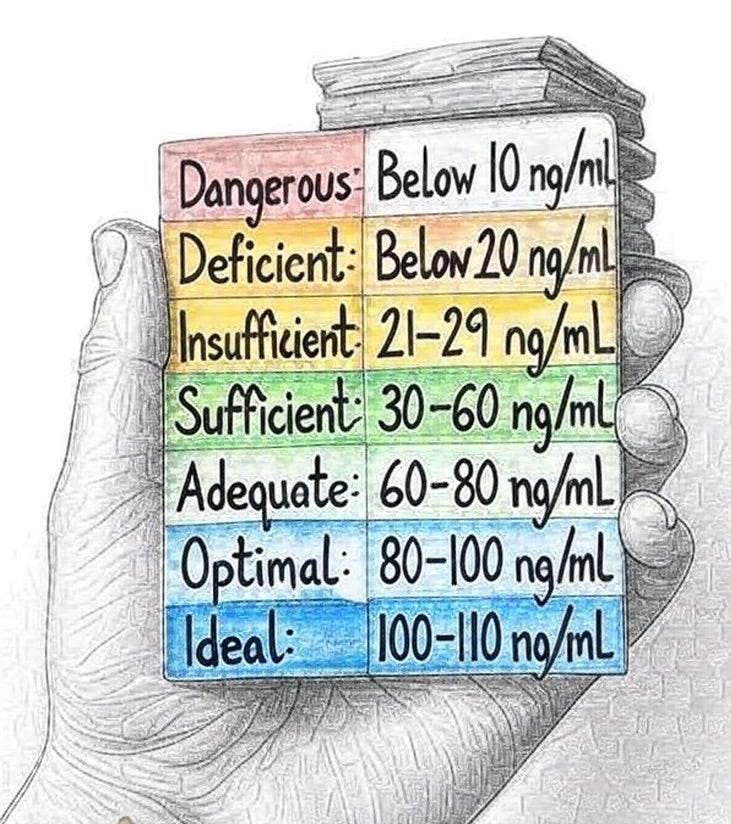
A blood test provides a clear picture of vitamin D status. Levels are typically categorized as follows (Holick et al., 2011; Wang et al., 2017):
Link to StarPowerLifeSciences.org for more information
First, consider that the skin makes vitamin D from the UVB rays in sunlight. Do you think we were designed to be poisoned by the sun? Of course not. What wild-eyed commentators fail to mention in their “vitamin D is rat poison” histrionics is the dose in the rat poison approaches 100 MILLION IUs. One hundred million. Not 5000, not 10,000 IUs but 100,000,000. Plus rat physiology is particularly sensitive to calcium dysregulation the 100,000,000 IUs would cause. The commentator uses percentages to distort the ratios to lead you to conclude that the vitD content is small (which it is relative to the filler in the bait) when in reality the vitD is astronomical compared to physiological needs.
If you feel that vitD is dangerous conduct your affairs accordingly. Better yet, perhaps getting them in order would be a better use of the time you’ll have left if you shun the sun and vitD.
Hello and thank you for your work.
What do you think of Dr. Jaimie Andrews' work on vitamin D,
https://controlstudies.substack.com/p/the-vitamin-d-hoax?utm_source=post-email-title&publication_id=2692591&post_id=201210611&utm_campaign=email-post-title&isFreemail=true&r=15jhwb&triedRedirect=true&utm_medium=email
which he describes as a poison? How is it possible today that serious experts, with nothing left to prove, can be diametrically opposed on such an important, well-studied, and seemingly simple subject? Is this due to the ongoing debate about the real existence of vitamins? Thank you for your feedback. Sincerely, P. Lasbats.