

Pain and Vitamin D
High dose vitamin D greatly reduces the perception of chronic low back pain

The focus of this Substack is the effects of high-dose vitamin D on physiology, behavior and well-being. Unfortunately, many “studies” examining the effects of vitamin D on various systems are designed to fail. Designed to fail by using too low a therapeutic dose of vitamin D, using D2 instead of D3, not varying the dose of vitamin D to generate a dose-response curve, not giving vitamin D enough time to work, or not measuring vitamin D levels before, during and after the study.
High-Dose Vitamin D Supplementation Alleviates Chronic Low Back Pain
The following study is a great example of an experiment well-designed to find the effect of vitamin D supplementation on chronic pain perception if there is indeed such an effect.
People who suffer with chronic low back pain also experience severe vitamin D deficiency compared to unaffected persons. Estimates are that 83% with chronic low back pain have vitamin D levels below 15 ng/mL (Plotnikoff & Quigley, 2003)
A clinical trial published in Pain Physician showed that high-dose vitamin D supplementation significantly reduced pain and improved function in individuals suffering from chronic low back pain who are also deficient in vitamin D.
The experiment was conducted in the Indian subcontinent where, somewhat surprisingly, 50-90% of the population is vitamin D deficient. In fact, a study that measured the serum levels of 25(OH)D in rural and urban Indian subjects found that 83.5% of males and 99% of rural females, and 88% of urban and 96% of urban females had deficient vitamin D levels, that is <30ng/mL (Harinarayan, et al., 2007).
The research, conducted by Ghai et al. (2017), enrolled 68 patients with chronic low back pain lasting three months or more, a pain score of at least 50 on a visual analogue scale (VAS, see explanation of what VAS is below*), and plasma 25-hydroxyvitamin D3 levels below 30 ng/mL.
The study administered a weekly dose of 60,000 IU of oral vitamin D3 for eight weeks, which averages to over 8,571 IU per day.
The supplementation regimen successfully raised vitamin D levels, with the average starting baseline of 12.8 ng/mL increasing to 36.07 ng/mL after the eight-week period. Following the treatment, 66% of the patients achieved normal vitamin D levels.
The study reported a significant reduction in pain scores at two, three, and six months post-supplementation compared to baseline levels. Similarly, patients experienced a significant improvement in functional ability, as measured by the modified Oswestry disability questionnaire, at the same follow-up intervals. The researchers also noted that a substantial portion of patients, 53% at three months and 63.2% at six months, achieved effective pain relief, defined as a 50% or greater reduction in their pain score.
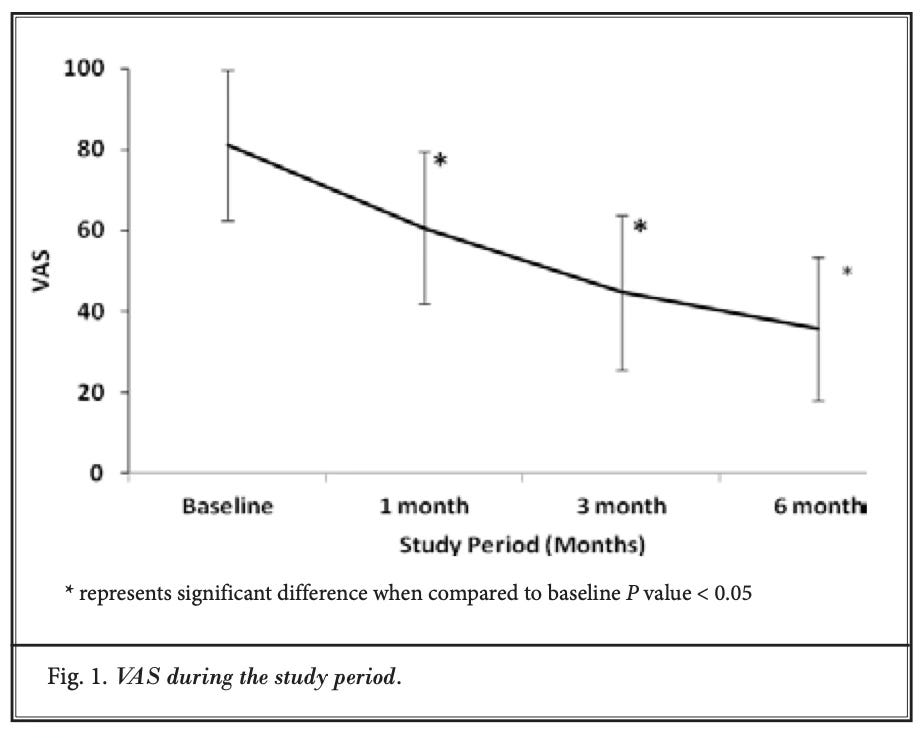
Figure 1: Reduction in perceived pain at one, three and six months after 8571 IU vitD3/day for eight weeks.
The authors of the study concluded that vitamin D supplementation in deficient patients with chronic low back pain leads to reduced perceived pain intensity and enchanced functional ability, in addition to correcting the vitamin D deficiency itself.
So this is a very interesting finding for several reasons. First of which is that there may be a simple solution to chronic low back pain that we’re missing out on, that being adequate vitamin D. We’ll discuss possible mechanisms shortly.
The second was the prevalence of vitamin D deficiency in India. I don’t know much about India other than it’s crowded and hot. Hot usually means lots of sun and vitamin D. I was surprised that vitamin D deficiency is a problem in India. So a logical question to ask is the obvious one: if vitamin D is involved in alleviating chronic low back pain and Indians are chronically vitamin D deficient on an epic scale, how prevalent is chronic lower back pain in India? The percentage of the Indian population with chronic low back pain varies by study and definition, but a 2022 meta-analysis reported a pooled lifetime prevalence of 66% and a 1-year prevalence of 51%. Studies show higher prevalence rates among women, rural populations, and certain workers. For instance, one study found 80% of Indian women aged 20-50 reported chronic pain, with chronic lower back pain being a major component.
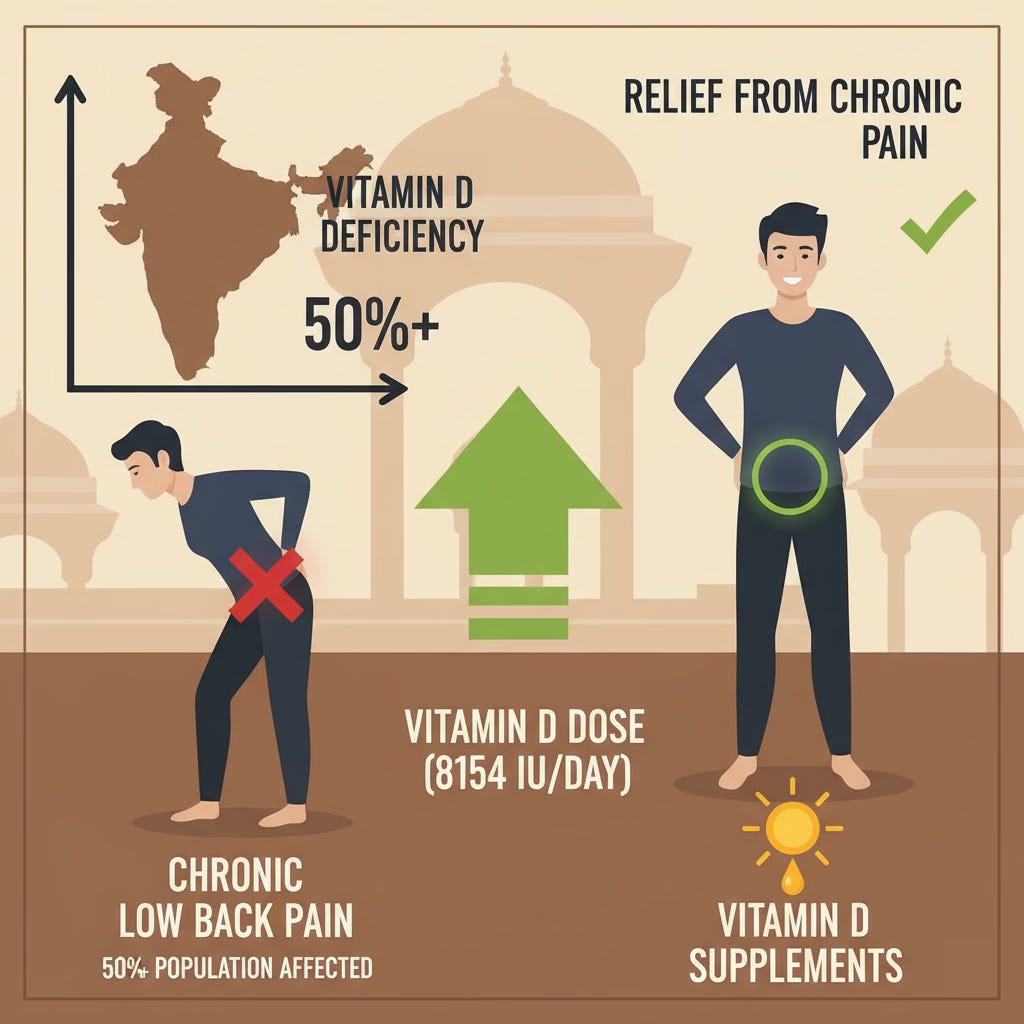
Chronically vitamin D deficient Indians suffer from epidemic levels of chronic low back pain and the study we just reviewed indicates that vitamin D supplementation using therapeutic, physiologically-relevant doses of vitamin D3 (8154 IU/day) alleviates chronic low back pain.
How Might Vitamin D Reduce Lower Back Pain?
There are two likely mechanisms through which chronic vitamin D deficiency could mediate chronic low back pain. First, the diffuse pain in bones and muscles, weakness, and paresthesia may be caused by chronic vitamin D starvation. Second, vitamin D starvation could play a role in the development of degenerative changes in the spinal discs via the increased susceptibility to inflammation in the vertebral end plates (Jones & Hansen, 2009).
Either way, a simple solution to the complex problem of chronic low back pain could be as simple as restoring serum vitamin D levels to an optimal, therapeutic level.
*The Visual Analogue Scale (VAS) is a widely used tool for measuring the intensity of pain and other subjective sensations. It is a simple and effective method for individuals to communicate the severity of their pain to healthcare providers. The scale consists of a straight line, typically 10 centimeters long, with endpoints that represent the extremes of pain experience.
How it Works: One end of the line is labeled “no pain,” and the opposite end is labeled “the worst pain imaginable” or a similar phrase. The patient is asked to mark a point on the line that corresponds to the level of pain they are currently feeling. The scale can be presented either horizontally or vertically.
References
Ghai, B., Bansal, D., Kanukula, R., Gudala, K., Sachdeva, N., Dhatt, S. S., & Kumar, V. (2017). Vitamin D Supplementation in Patients with Chronic Low Back Pain: An Open Label, Single Arm Clinical Trial. Pain physician, 20(1), E99–E105. https://pubmed.ncbi.nlm.nih.gov/28072801/
Harinarayan, C. V., Ramalakshmi, T., Prasad, U. V., Sudhakar, D., Srinivasarao, P. V., Sarma, K. V., & Kumar, E. G. (2007). High prevalence of low dietary calcium, high phytate consumption, and vitamin D deficiency in healthy south Indians. The American journal of clinical nutrition, 85(4), 1062–1067. https://doi.org/10.1093/ajcn/85.4.1062
Jones, A. N., & Hansen, K. E. (2009). Recognizing the musculoskeletal manifestations of vitamin D deficiency. The Journal of musculoskeletal medicine, 26(10), 389–396.
Plotnikoff, G. A., & Quigley, J. M. (2003). Prevalence of severe hypovitaminosis D in patients with persistent, nonspecific musculoskeletal pain. Mayo Clinic proceedings, 78(12), 1463–1470. https://doi.org/10.4065/78.12.1463
Shetty, G. M., Jain, S., Thakur, H., & Khanna, K. (2022). Prevalence of low back pain in India: A systematic review and meta-analysis. Work (Reading, Mass.), 73(2), 429–452. https://doi.org/10.3233/WOR-205300
Included in all posts
General Recommendations for Vitamin D for Healthy Adults
The U.S. Institute of Medicine (IOM), now the National Academy of Medicine, recommends a dietary reference intake of 600 IU (International Units) per day for adults up to age 70, and 800 IU for those over 70, to maintain bone health (Institute of Medicine, 2011). However, this amount is orders of magnitude too low considering that the human body “uses” at least 4000 IU vitamin D per day.
However, there is a vast literature on the extraskeletal functions of vitamin D for maintaining optimal functioning of the immune system, muscular system and ideal aging that indicates that optimal levels of serum vitamin D are much, much higher (e.g., Grant et al. 2020).
Based on Blood Levels
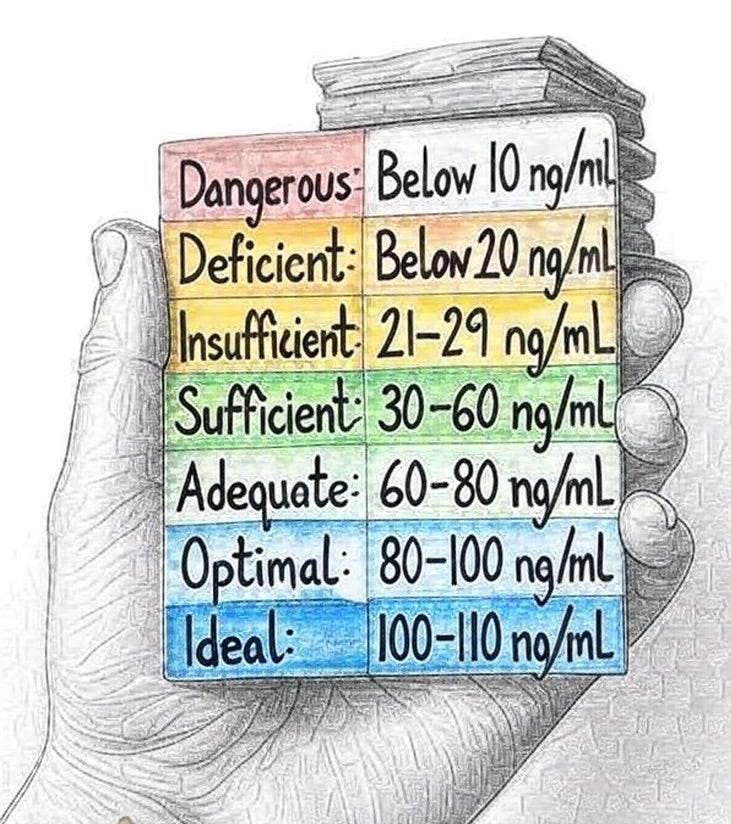
A blood test provides a clear picture of vitamin D status. Levels are typically categorized as follows (Holick et al., 2011; Wang et al., 2017):
First: how about vit K2 and Magnesium, they should accompany vit D suppletion! Has to do with calcium.
Second: if you have (low back) pain, it's a signal there is something wrong, and that can be the bones, the muscles, nerves etc etc.
Third: as a triggerpoint and energy therapist, i have seen low back pain disappear after removing triggerpoints, eg in the quadratus lumborum. You don't need extra vit D for that. But you have to find out why you got triggerpoints, and that could be vitamin D3 deficiency, other vitamins, magnesium etcetera.
Forth: it is interesting to find out where this vit D deficiency comes from, in India, but also the rest of the world. Long ago, in traditional communities there was ancient nutrition wisdom. People knew exactly what to eat and what not, all over the world, and were very healthy. That was destroyed by "modern" western food. Read "Nutrition and physical degeneration" by Weston A Price.
Excellent! I believe this to be true via personal experience.
I too thought "how odd that Indians in India could possibly be deficient in vitamin D"
Too much sun for me to even visit India, I am fair skinned northerner.
You've got to ask how a HOT sun soaked continent could have a vitamin d deficiency.
I wonder if synthetic suns with trillion watt LED bulbs & mirrors in the upper atmosphere while using chemical and metallic aerosols to occult the organic sun could be the reason for these deficiency reports.